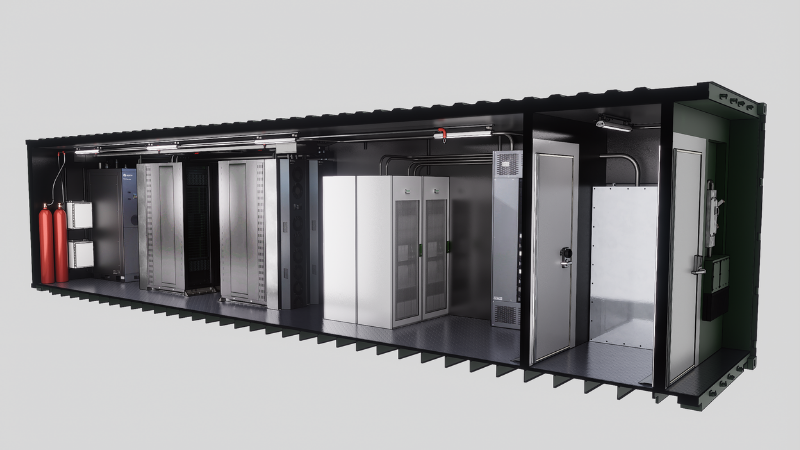
Data processing does not always need to happen inside a large, traditional data center. There is an increasing need for computing infrastructure closer to where data is generated and used. A micro data center, like CenCore’s TRIDENT and STRIDE solutions, provides a compact way to establish compute capacity without relying on centralized data centers.
A micro data center is a small, self-contained computing environment designed to provide essential data center infrastructure within a limited footprint. Depending on the requirement, it can support computing, storage, networking, power, cooling, and security closer to the point of operation.
This makes micro data centers particularly useful for edge computing and other applications where organizations need reliable data processing outside traditional data centers.
Unlike traditional data centers that typically rely on permanent utility connections, micro data centers can be designed to operate with mobile power sources, including generators. CenCore’s micro data centers are designed to be compatible with external power solutions, providing greater deployment flexibility in locations where grid power is unavailable, unreliable, or limited.
Micro data centers can take different forms, including containerized and modular data center solutions, depending on capacity, security, scalability, location, and deployment needs.
How Does a Micro Data Center Work?
A traditional data center houses computing infrastructure within a dedicated facility. A micro data center concentrates essential infrastructure into a much smaller environment.
Instead of sending all data back to a centralized data center, organizations can position computing resources closer to the systems and operations generating that data. This supports edge computing by bringing data processing closer to the point where information is collected and used.
The exact infrastructure depends on the application. Power, cooling, networking, computing equipment, and security can all become important parts of the overall micro data center environment.
For operations in remote or mission-critical locations, this distributed approach can also reduce dependence on permanent data center infrastructure.
What Are Micro Data Centers Used For?
Micro data center deployments can support environments where computing must be positioned closer to users, equipment, sensors, or mission operations.
Applications for micro data centers include:
- Remote computing environments
- High-performance computing
- Distributed computing infrastructure
Localized computing can support mission software, ISR data processing, classified workloads, and other requirements that need computing capability closer to the point of operation.
The core advantage is flexibility. Instead of requiring every workload to operate from a traditional data center, a micro data center creates additional options for placing compute capacity where it is needed.
Micro Data Centers and Edge Computing
Edge computing moves computing resources closer to where data is created and used. Micro data centers support this distributed approach by placing data processing and computing capabilities closer to the workload.
This is why micro data centers are commonly associated with edge computing. They provide a smaller infrastructure footprint without requiring a conventional data center facility at every location.
A containerized data center can serve as a micro data center by placing computing and supporting infrastructure within a self-contained, deployable platform. This provides another way to support edge computing while maintaining a compact infrastructure footprint.
Micro Data Center vs. Traditional Data Center
The largest difference between a micro data center and a traditional data center is the scale and placement of the infrastructure.
A traditional data center generally concentrates computing infrastructure within a dedicated facility. A micro data center provides a more compact environment that can be positioned closer to the application or operation it supports.
Micro data centers can complement centralized data centers instead of replacing them entirely. Their smaller footprint also makes them relevant when organizations need data center resources across multiple locations.
The physical design can vary based on the application, with containerized and modular infrastructure providing different options for deployment.
Containerized Micro Data Centers
A containerized data center packages computing infrastructure into a standardized ISO container, creating a self-contained platform that can be deployed where computing capability is required.
CenCore’s TRIDENT Containerized Data Center provides secure, high-density computing at the edge. TRIDENT supports 20-foot and 40-foot ISO container deployments with air-cooled or direct liquid-cooled architectures.
TRIDENT EDGE provides single-container compute infrastructure designed for deployment closer to the point of operation. For larger computing requirements, TRIDENT CORE expands this capability into a multi-container architecture with separate power and an integrated cooling infrastructure depending on mission requirements.
This allows TRIDENT to support micro data center applications through compact EDGE deployments while scaling to larger computing requirements through CORE configurations.
Scaling with Modular Data Centers
While micro data centers support compact computing requirements, larger operations may require additional capacity and room for expansion. Fixed-site and semi-permanent environments may benefit from a modular data center designed around scalability and future expansion.
CenCore’s STRIDE Modular Data Center is a non-ISO platform designed for scalable computing infrastructure in fixed-site and semi-permanent operations. STRIDE EDGE provides a single, self-contained module with integrated cooling and can serve as a micro data center when a requirement calls for a non-ISO footprint. STRIDE CORE connects multiple modules with a separate cooling system, scaling well beyond micro data center capacity for larger deployments.
Choosing the Right Data Center Solution
The right micro data center configuration depends on where the infrastructure will operate and what it needs to support.
Organizations should consider:
- Required compute capacity
- Power and cooling requirements
- Need for rapid deployment
- Fixed, semi-permanent, or deployable operations
Containerized infrastructure can support requirements where a self-contained, deployable platform is needed. Modular data centers provide another option for fixed or semi-permanent environments where scalability is a priority.
Micro Data Centers for Mission-Critical Computing
For mission-critical environments, data processing, power, cooling, networking, security, scalability, and deployment requirements can all influence infrastructure design.
CenCore’s TRIDENT provides containerized infrastructure for processing, storage, analytics, and secure computing environments. Its EDGE and CORE configurations provide options for single-container and multi-container requirements.
STRIDE provides scalable modular infrastructure for fixed-site and semi-permanent computing environments, with single-module and multi-module configurations designed around different capacity requirements.
Together, these platforms provide different approaches to micro and edge data center infrastructure based on operational requirements.
Micro Data Centers Built Around the Mission
A micro data center brings computing and data processing closer to where information is generated and used, with power planned in from the start. Explore CenCore’s TRIDENT and STRIDE solutions to find the right infrastructure for your mission.
For more information, contact us.
Frequently Asked Questions (FAQ)